Welcome to your SEO learning journey!

You’ll get the most out of this guide if your desire to learn search engine optimization (SEO) is exceeded only by your willingness to execute and test concepts.
This guide is designed to describe all major aspects of SEO, from finding the terms and phrases (keywords) that can generate qualified traffic to your website, to making your site friendly to search engines, to building links and marketing the unique value of your site.
1. Publish Relevant, Authoritative Content
Quality, authoritative content is the number one driver of your search engine rankings and there is no substitute for great content—this is especially true when doing SEO marketing. Quality content created specifically for your intended user increases site traffic, which improves your site’s authority and relevance. Fine-tune your web writing skills and present yourself as an authority on the topic you are writing about.
Keywords
Identify and target a specific keyword phrase for each authoritative content page on your website. Think about how your reader might search for that specific page with search terms like:
- online masters in engineering management
- what is biomedical engineering?
- title IX education resources
- photographing northern lights
- how to apply for scholarships?
- when is the FAFSA deadline?
- what is the difference between engineering and engineering technology?
2. Content
Beyond page URL, title, and headings, content is most influential on search engine rankings. Repeat your keyword phrase several times throughout the page—once or twice in the opening and closing paragraphs, and two to four more times throughout the remaining content. Be authoritative. Strategically link to relevant sources and additional information—both within your organizations broad website and even to other websites which are useful.
3. Quality Links
WordPress offers a few options when it comes to how your permalinks get generated. Go under Settings > Permalinks and set how you want URLs to include details like your post name. Customizing the URLs in this way (using your post name) makes your URLs more searchable. If you want to completely customize them, you can choose that option as well. Below, you can see “Post name” is selected, which uses your post name as the URL, and “Custom Structure” below that lets you completely customize it. Warning: if you have existing pages that are already getting traffic, changing those URLs now can affect your SEO ranking.
4. Off-Site Optimization (aka Link Building)
Link building is probably one of the most talked-about (and debated about) SEO tasks. The basic goal of link building is to get other websites to link to yours. If you think about ranking at the top of search results as a popularity contest, then links are like votes saying your website deserves to be ranked highly. Getting links with keyword anchor text will help you rank specifically for the keywords that are linked to. For example, Adobe Reader ranks number one for the keywords click here because so many websites linked to it using the anchor text click here to download Adobe Reader.
- Organic Links – These are links you don’t have to ask for, and they are the best kind. Especially if you can get them on sites with high authority such as major news outlets and other well-recognized name websites.
- Whitehat – This basically stands for good, quality link building (the kind you should strive for).
- Blackhat – This stands for spammy, low-quality link building (the kind you should avoid).
5. How Google+ Can Help with Rankings
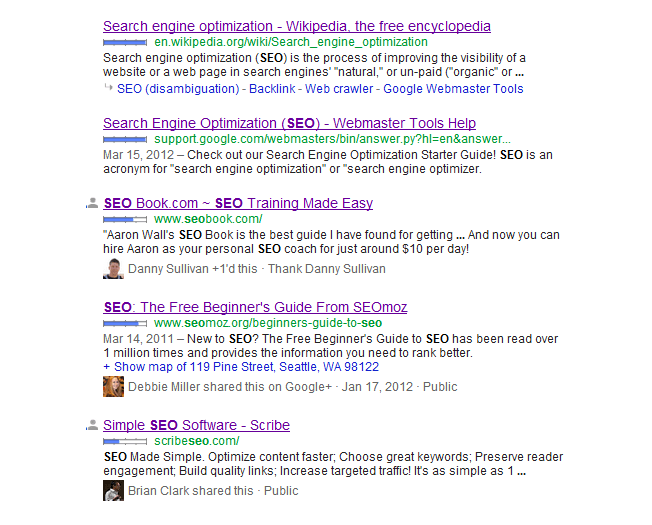
Speaking of creating social profiles for links, if your goal is to dominate Google, then you should make sure you join Google+. Google’s own social network can help you rank better in search results for people you are connected with. For example, when I’m logged in to Google+ and I search for SEO, I get the following in my top five search results. Personalized search results based on who I am friends with are marked by the little person icon.
6. Optimize Title Tags
Title tags are slowly losing organic ranking power, but they remain important. Including keywords in the title informs Google of the page’s purpose. Moreover, a well-crafted title will likely be the most visible portion of a standard search-result snippet. Thus it can impact click-throughs, too.

07. Check that your site is mobile friendly
Another essential element of SEO is ensuring that all searchers can reach your site and have a positive user experience. In today’s world, over 50% of all traffic comes from mobile devices. That means that it’s well worth your while to ensure that your site is mobile friendly.
Not only will this boost your business and ensure that people searching from their phones can use your site, but it is also important to Google. The search engine often employs mobile first indexing, which essentially means that it crawls the mobile version of your site in order to determine how it should rank amongst its results. That’s why the mobile version of your site deserves your undivided attention.
08. Analyze results
Since SEO is a living and breathing task, you have to be sure to consistently assess your pages’ performance and tweak accordingly. You can check your page rankings and performance with SEO tools like Ahrefs and Google Search Console in order to get a sense of the direct impact of your optimization. These tools can help you understand if your site has improved in the rankings and note which keywords your site is ranking well for. If you’re unhappy with your rankings or traffic, you can consider all of the previous items on this list and tweak your content accordingly.
 Azmair
Leave a comment